Posts

American Teacher Fights To Survive

Image
Competing for space in the American mind, which Allan Bloom famously declared closed more than twenty years ago, we have unemployment, a recessed economy, two wars, and a confederacy of dunces vying to be the next leader of the self-proclaimed “greatest country on earth.” Somewhere in the middle of that pack is American education. Every yahoo running for political office from dog catcher to president wants to be known as the education candidate. Yet once in office, those same politicians offer the old tired mantras of standardized test scores and teacher accountability. We must return America’s students to the top of the heap in math and science, they bray. Let’s hope they can read, too. We have been treated to a number of documentaries in the local cinema over the last few years regarding our education problems in America. There was the much ballyhooed Waiting For “Superman,” (2010) by the people who brought us global warming and the Al Gore PowerPoint lecture; there were also a num...

Here There Are Only Ghosts

Image
For many of us, “Childhood is the kingdom where nobody dies. Nobody that matters, that is,” as Edna St. Vincent Millay wrote in 1937. It is in our sepia-toned memories of childhood that our futures are born. Never is this nostalgia for our remembrances of things past more evident than in our literature of reflection, the coming-of-age story so prevalent in our life of letters. Giuseppe Tornatore , writer-director of the Italian film Cinema Paradiso (Miramax Films Presents, 1988; Miramax Classics, 2004), explores his remembrances of his post-war childhood through the experiences of Salvatore “Toto” Di Vita, a fictional, well-known movie director who is forced to re-examine his life’s journey upon the death of his mentor, Alfredo. “Tornatore pays homage to the American, Italian, and European films that influenced him as a child and as a director,” Stanislao G. Pugliese writes in The American Historical Review . The film had a troubled, but ultimately successful history. The first cut ...

One Day I Will Write About This Place

Image
It is always interesting to pick up literature originating in another culture and find echoes of our own. In that spirit, I was intrigued by Binyavanga Wainaina’s coming-of-age memoir, One Day I Will Write About This Place (Graywolf Press, 2011) , set on another continent and within a completely different culture. Wainaina writes about growing up in Kenya, the tensions among tribes and factions, his own mental breakdowns and inadequacies, and finally, his triumph upon finding his path in life centered on the twin suns of writing and literature. Even in his darkest moments, it is reading that saves him, and writing that allows him to capture the fertile decadence of his African life. Wainaina writes how he loses himself in literature, devouring books like a man steeped in hunger. This rabid reading habit comes at the expense of his social life and education. “I do not concentrate in class,” he says, “but I read everything I can touch.” The echoes of American cultural influence come in ...

Personal Matters

Image
I spend my days working with individual writers on papers for their college classes. For the most part, these papers are research-based analysis of topics within the disciplines of sociology, medicine, and psychology. I spend time reading through the essays, marking them up, correcting grammar and format, and making suggestions on how to bring out the strengths and minimize the weaknesses in the writer’s work. I have, however, learned to go easy on one aspect I always find missing from scientific research and analysis: the first person pronoun “I.” Most teachers do not allow the use of “I.” “You must be objective,” they tell the students. “Only the facts and your analysis.” Some of the papers this semester focused on the film, Mysterious Skin (2004), a rather intense and graphic depiction of child sexual abuse and its effects on the lives of two boys. Many of the students found the film disturbing on many levels, and a few struggled to even write about it with any kind of depth or dis...

Selling (And Saving) Catholic Schools

Image
According to Monsignor Charles Pope, writing from the Archdiocese of Washington this past summer, “over 6,000 [Catholic] schools have closed since 1970.” Andy Smarick, in National Affairs (Issue Number 7, Spring, 2011) tells us that the decade of the 1970s saw 1,700 schools close. He goes on to say that Catholic schools are as American as George Washington, and were here before the Revolution began. In fact, he says, “these schools long pre-date the American founding.” The first Catholic school, started by Franciscans, opened in Florida, circa 1606. The Jesuits “founded a preparatory school for boys in Newton, Maryland” in 1677. “In the early 1800s, parochial schools—those affiliated with parishes—emerged and became the foundation for Catholic elementary schools.” Across the country and around the world, millions of students have been educated in Catholic institutions. They have gone on to give back to the world as doctors, lawyers, artists, thinkers, and business leaders. A Catholi...

Blue Mornings

Image
This piece was written for the Daily News in Los Angeles on the occasion of the paper’s centennial. I will never forget flying through the dawn. In many ways, those mornings in the eastern San Fernando Valley delivering the Daily News shaped my entire life. I started my delivery service when the paper published on selected days of the week. By the end of my time, the Daily News was a seven-day-a-week publication with a unique valley slant. There were no mornings off for us carriers. I pedaled my ten-speed furiously through the neighborhood, racing the sun to get all my papers delivered and get back home to get ready for school. My salary helped pay for my Catholic school education and relieve the financial burden on my working class parents. My daily journey was an adventure, fraught with a hint of danger and full of hidden secrets in the darkness. There was the vicious mutt that stalked me. He ran loose in the neighborhood and would lie in wait to launch himself out of the dark sh...

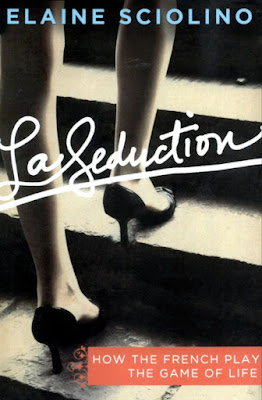
La Seduction

Image
Americans have their stereotypical views of the French, which is why every American should read Elaine Sciolino’s book, La Seduction: How The French Play The Game Of Life (Times Books/Henry Holt and Co., 2011). Sciolino is the former Paris bureau chief for The New York Times and was once a foreign correspondent for Newsweek . Currently, she lives in Paris with her husband, an American lawyer who practices with a French law firm. Her goal in the book is to examine the way seduction is an integral component of French culture and behavior. She begins with the custom of the male kissing the hand of a woman to whom he has been introduced. The kiss is not romantic or passionate; it is offered like Americans offer each other their hands in greeting, but it is intimate and unique to French custom. It is all part of the way France integrates the fine art of seduction into every day life. “In English,” Sciolino writes, “‘seduce’ has a negative and exclusively sexual feel; in French, the meanin...