Posts

Showing posts with the label technology

Is Wikipedia Dying? (With Parenthetical Annotations)

Image
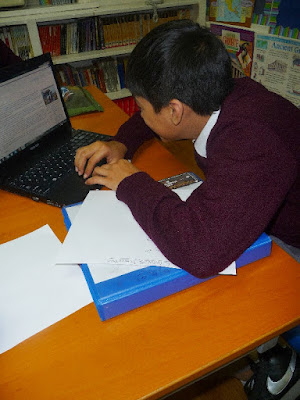
I hear teachers telling classes this all the time.   I, myself have told students the same thing.   Wikipedia , the online “free encyclopedia” is not a good source for research writing and should never appear in any self-respecting researcher’s bibliography.   The site is good for a quick overview or to cannibalize the entry’s references list to look up sources, but woe to the student who dares to identify information taken from the site and placed in a paper, or worse, one who plagiarizes from the text of an article without attribution. ( The latter is like murdering someone and then punching the corpse in the nose in the eyes of most educators. ) Now all that may be changing.   Wikipedia has managed to get itself a whiff of legitimacy.   But it may be too late.   According to Andrew Lih in a recent opinion piece in The New York Times , Wikipedia may be facing an uncertain future. The site students know as Wikipedia began life in 2001.   Today, it ...

Bibliotech

Image
I guess it is my fault that I found John Palfrey’s book, Bibliotech:  Why Libraries Matter More Than Ever in the Age of Google (Basic Books, 2015) somewhat disappointing.   I was looking for the very thing Palfrey says his book is not:   a paean to the libraries of the past offering a nostalgic, wistful, sepia-toned wish for a time now long gone.   He does admit that there is much to celebrate and love “about the libraries of the past,” but he is administering here what he calls “a dose of tough love.”   How can these institutions survive and even thrive in the burgeoning information age?   That is the question Palfrey seeks to answer. From the start, Palfrey makes clear he is a “feral,” a “nonlibrarian who ends up working in a library.”   He believes the institutions are at risk “because we have forgotten how essential they are” in this age of Google and Wikipedia.   He calls libraries essential cogs in the wheels of democracy, and believes the...

Book Was There

Image
When any writer takes on the subject of reading in the digital age, he must understand that this is not new territory.   The digital age is aging, and the landscape shifts like sand on the beach at high tide.   To me, there is no better book about the state of reading right now than Sven Birkerts’ The Gutenberg Elegies (Faber & Faber, 2006).   However, there is always more to be said, and in that spirit, Andrew Piper takes a crack at 21 st century reading in his 2012 entry, Book Was There:  Reading In Electronic Times (University of Chicago Press, 2012). From the start, Piper assures us that the current so-called crisis in reading is nothing new.   It is true:   reading books has withstood the challenge of movies, television, audio books, and e-readers, yet Bowker.com reports that more than three million hard copy books were published in 2010.   The big change in that statistic is the rise of print-on-demand titles, which accounted for approx...

Education Reform: Hold On To What Works

Image
I keep thinking about Socrates , there on the streets of Athens, asking questions.   No PowerPoints , no laptops, no iPads, just a man in a toga who hated one-word answers.   He didn’t even have a chalkboard. Why is educational reform tied to technology?   Technology is a tool, and certainly can enhance teaching, but increasingly, it has become the means and the end to everything.   Jobs depend on how often technology is used.   I know of a principal who insists her teachers use blogs, and demands they force their students to comment on those blogs.   The teachers must turn in a list of blogs they follow.   They must contribute videos and pictures to the school website.   They must maintain class pages, updated at least once a day, if not more often.   Textbooks are passé.   Everything that can be known is available on the internet, so who needs a book, right?   Of course, when the technology goes down, as it does so often, the t...