Posts

Showing posts with the label book review

Avid Reader

Image
“I began as I would go on—reading.”   Talk about fantastic first sentences.   Those words begin Robert Gottlieb’s memoir, Avid Reader:   A Life (Farrar, Straus and Giroux, 2016) and they immediately establish that even though Gottlieb has worked his entire life as an editor, first at Simon and Schuster, then at Knopf, and after that, at The New Yorker followed up with freelance editing, service to the board of the New York City Ballet, and finally, as a writer, he remains at heart a reader.   He has edited everything and everyone, from literature to trash, and he recounts in detail the struggles and triumphs of the written word shaped by a writer and a good editor. The story begins at the beginning with a tale of how a boy became a reader and then an editor.   It is full of magic moments with books and texts, and for the diehard book-lover who thrives on the printed word, there is a lot to be thrilled about in this book.   Gottlieb reinforces the idea th...

A Genius In A Vanished World

Image
We were the only two people in the darkened theater.   One entire row of seats had been roped off because they were damaged when part of the ceiling fell.   The place smelled of stale popcorn and body odor, and we had to wipe the accumulated buttery grease off of the vinyl seats before gingerly sitting down to await the show.   The film was Genius (Lionsgate, 2016), starring Jude Law and Colin Firth and directed by Michael Grandage.   I knew of Max Perkins and his editing work with most of the major writers of the early 20 th century:   Ernest Hemingway, F. Scott Fitzgerald, and Thomas Wolfe.   I knew he had performed more than just editing tasks for his writers, including being a surrogate father-figure.   But what unfolded in front of me over the next 104 minutes was something I had not seen before.   Grandage had managed to illustrate and dramatize what was not considered all that interesting:   a person editing a manuscript.   Gran...

At The Existentialist Cafe

Image
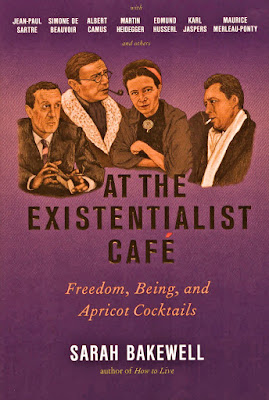
“To philosophize is to learn how to die.” (Cicero) There are books we remember all our lives.   We remember where we first read them, the way they made us feel, the way the world seemed so fresh, so colorful, so new when we finished the last page.   We remember how we never wanted them to end. I had that experience reading Sarah Bakewell’s At The Existentialist Café:  Freedom, Being and Apricot Cocktails (Other Press, 2016).   I knew Bakewell was good— I reviewed her book on Montaigne a few years ago—but this is a masterwork of biography not just of a person, but people, places, a philosophy and a way of life.   In fact, early on, she calls Existentialism more a mood than a philosophy and traces its lineage back to Job and Ecclesiastes in the Bible, up through St. Augustine and Blaise Pascal, to Jean-Paul Sartre, Simone de Beauvoir, Albert Camus , Martin Heidegger, Edmund Husserl, Karl Jaspers, and Maurice Merleau-Ponty.   The last seven names are the ...

The Good Death

Image
“There is no good death, I now know,” writes Ann Neumann at the end of The Good Death:  An Exploration of Dying In America (Beacon Press, 2016).   “It always hurts, both the dying and the left behind.”   What comes before this apt and powerful conclusion is a personal and ethical pursuit of the truth on the part of Neumann inspired by the slow decline and death of her father.   Her exploration of the truth about end of life issues is not pretty even as it is also wise and eloquent, a contradiction—a good death with all the sights, smells, and fearful symmetry of how we end.   This is the one constant in human existence:   death comes, no matter how much science and medicine work to stave off the inevitable.   Death comes.   So we ask ourselves:   are we ready for the inevitable? “Grief, I learned, is a journey,” she writes in the midst of witnessing her own father’s end.   “The work of mourning is easier to explain than the emotion of ...