Posts

Education Reform: Hold On To What Works
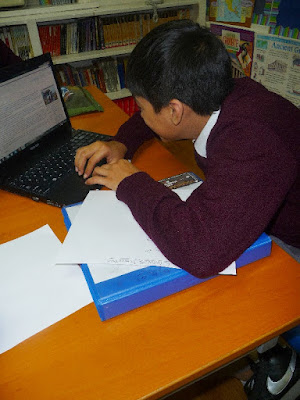
Image
I keep thinking about Socrates , there on the streets of Athens, asking questions.   No PowerPoints , no laptops, no iPads, just a man in a toga who hated one-word answers.   He didn’t even have a chalkboard. Why is educational reform tied to technology?   Technology is a tool, and certainly can enhance teaching, but increasingly, it has become the means and the end to everything.   Jobs depend on how often technology is used.   I know of a principal who insists her teachers use blogs, and demands they force their students to comment on those blogs.   The teachers must turn in a list of blogs they follow.   They must contribute videos and pictures to the school website.   They must maintain class pages, updated at least once a day, if not more often.   Textbooks are passé.   Everything that can be known is available on the internet, so who needs a book, right?   Of course, when the technology goes down, as it does so often, the t...

The Lost Narrative of Mitt Romney

Image
The New York Times recently ran an essay by Frank Bruni that made some excellent points.   This presidential race is shaping up to be one devoid of a story, and story is how we live.   Human beings need a compelling narrative.   Barack Obama had one in 2008, the first black man to run for president, the man for change, the man for hope.   He wasn’t totally convincing.   I’m not sure when the book gets written or the movie made, if the audience will find his story a bit trite, or contrived.   He made the attempt to fashion a narrative, and it worked.   He got elected. Bruni writes:   “If you have any kind of heart, you’re struck by it:   the photograph of Barack Obama bent down so that a young black boy can touch his head and see if the president’s hair is indeed like his own.”   Yes, a nice, photogenic moment that tells a story.   “And that gives many voters an emotional connection to him that they simply don’t have to most othe...

The Poetry of This Moment

Image
Here comes summer with all its warm nights and whispers, the glow of televisions in windows up and down the block.  The heat never fully leaves, but the dawn brings some cool relief, damp and full of promise.  These are the nights I stay up late, reading, thinking, considering the stars. The struggle comes with the switch to summer living.  I am not good with down time.  I crave the pressure, the busyness of a full daily schedule.  Then summer hits, and suddenly things slow a bit, switch tempo, start a new song.  And I am left out of the dance. I have projects waiting, writing to be done, but somehow, I wander through the days.  Evening comes and I wonder where the time went.  Meanwhile, others around me are busy.  Not everyone’s life slows down with summer. One of the hardest things for us to do is live in the moment.  The Book of Ecclesiastes tells us:  “One generation passes and another comes, but the world forever stays.  T...

Death and Death Revisited

Image
There is no doubt that in its time, Jessica Mitford’s   The American Way of Death Revisited (Vintage Books, 2000)  changed how the funeral industry does business in this country much the same way that Upton Sinclair’s The Jungle (See Sharp Press, 2003) changed the meat-packing industry in Chicago.  Mitford, with diligence, grace, and humor, opened America ’s eyes.  The irony is that the book was almost dead before it saw the light of publication.  Houghton Mifflin, as Mitford recounts in the Introduction, thought the book too graphic, especially the details of the embalming process which happen to be the most interesting pages.  Luckily, Robert Gottlieb of Simon & Schuster stepped in to publish the original edition back in 1963. The book spawned legislation to regulate the funeral industry, and put undertakers, mortuary workers, funeral directors, or whatever name they go by these days, on notice.  These groups responded with negative ad campaign...

Lay Your Burden Down

Image
We cling to what we know.  We grab the knife by the blade end and grip it so tight even as we feel the cut deep into the thick flesh of our palm.  In the face of pain, we can’t let go.  Through the blood and suffering, we hang on with the desperation of a drowning man.  In the scope of years or the collision of circumstances, some of us learn an important lesson.  The daily scrapes and bruises finally register.  What should we do?  We must let go.  In life, as soon as we latch on to something, it is a safe bet that the ground beneath our feet will shift.  The only constant is that nothing is constant.  Everything must change or die. This is the message of Thich Nhat Hanh’s book, Anger:  Wisdom for Cooling the Flames .   Indeed, it is a consistent theme in every treatise of eastern philosophy or Zen Buddhism.  When anger rises, according to Hanh, we must concentrate on breathing or walking, and simply recognize the feeling...

A Different View

Image
“…for here there is no place that does not see you.  You must change your life.” (from   "Archaic Torso of Apollo" by Rainer Maria Rilke )                                                                                               For a while now, I’ve wanted to explore some other views in addition to The Teacher’s View .  I’ve taken a lot of freedom on these pages to cover a wide swath of subjects.  Truth is, I have always been more student of life than teacher.  Maybe, back in 2007, I should have called this blog The Student’s View .  We are always learning. What’s done is done, and I enjoy the freedom I’ve had on these pages to explore wherever my mind has wandered.  I expect to keep going with The Teacher’s View wel...

Iconography

Image
My interest in religious iconography goes back to my childhood in Catholic school.   I marveled at the way Catholic crucifixes and statues were always more graphic than our Christian counterparts whose churches often had a plain, wooden cross over the altar.   Catholic churches were known for their often bloody representations of Jesus hanging by nails on the rough wood.   Saints, too, especially martyrs, were depicted with flaming hearts, barbs and wounds, clearly in torturous ecstasy in their pain.   I remember one statue I saw when I was in second grade:   St. Lucy , patron saint of the blind, holding a plate with two eyeballs, visually telling the story of how she either had her eyes gouged out by her tormentors, or dug them out herself as sources of sin. Recently, I attended a dedication of a statue of Our Lady of Fatima on a local corner in my neighborhood.   During the Mass, the priest tried to make the case that Catholic worship of icons was not id...